
Dziś o książce “Alchemy”, autorstwa Rory’ego Sutherlanda.
Książkę tę przeczytałem podczas lotu na konferencję w Fields Institute – to jedna z moich ulubionych miejscówek konferencyjnych. Miałem tę książkę od dłuższego roku na półce, i mniej więcej wiedziałem o czym traktuje – w końcu Rory jest znanym mówcą, trochę youtuberem ;).
Alchemia – podtytuł to: The dark art of creating magic – niech powie sama o sobie (s.11): “Ta książka nie jest atakiem na liczne zdrowe zastosowania logiki czy rozumu, ale jest atakiem na pewien niebezpieczny rodzaj logicznego zapędzania się, który żąda, by każde rozwiązanie miało przekonujące uzasadnienie, zanim w ogóle zostanie rozważone czy choćby spróbowane. Jeśli ta książka nie da ci nic więcej, mam nadzieję, że da ci przyzwolenie, by od czasu do czasu proponować rzeczy odrobinę niedorzeczne. By ponosić porażki nieco częściej. By myśleć inaczej niż ekonomista. Istnieje wiele problemów odpornych na logikę, których nigdy nie rozwiążą ludzie aspirujący do udziału w Światowym Forum Ekonomicznym w Davos – tej osobliwej międzynarodowej wycieczce, podczas której z jakiegoś powodu najinteligentniejsi ludzie świata wspólnie uznają, że dobrym pomysłem jest spędzić część stycznia w połowie wysokości góry.”
Żeby od razu pokazać, o co chodzi w alchemi, wyobraź sobie portiera (doorman) w eleganckim hotelu. Z perspektywy logiki (autor ją różnicuje z psychologią), jego jedyne zadanie to otwieranie drzwi, co może być z perspektywy efektywności zastąpione przez automatyczne drzwi. Każdy analityk, dużej i małej czwórki ;), z arkuszem kalkulacyjnym skreśliłby go pierwszego – oszczędzamy kilka FTE! Tyle że otwieranie drzwi to tylko pozorna rola portiera. Jego prawdziwa wartość siedzi w czynnościach/funkcjach, których nie da się łatwo zmierzyć: łapie taksówki, pilnuje bezpieczeństwa, odgania natrętów, rozpoznaje stałych gości, a przede wszystkim sygnalizuje prestiż całego hotelu. Efekt? Sama jego obecność pozwala podnieść cenę za nocleg (s.126). To właśnie ta magia, która umyka czystej logice.
Zachęcony grafikami tworzonymi przez prof. Pawła Prałata, tutaj moja próba pokazania o co chodzi w książce, na małej grafice.
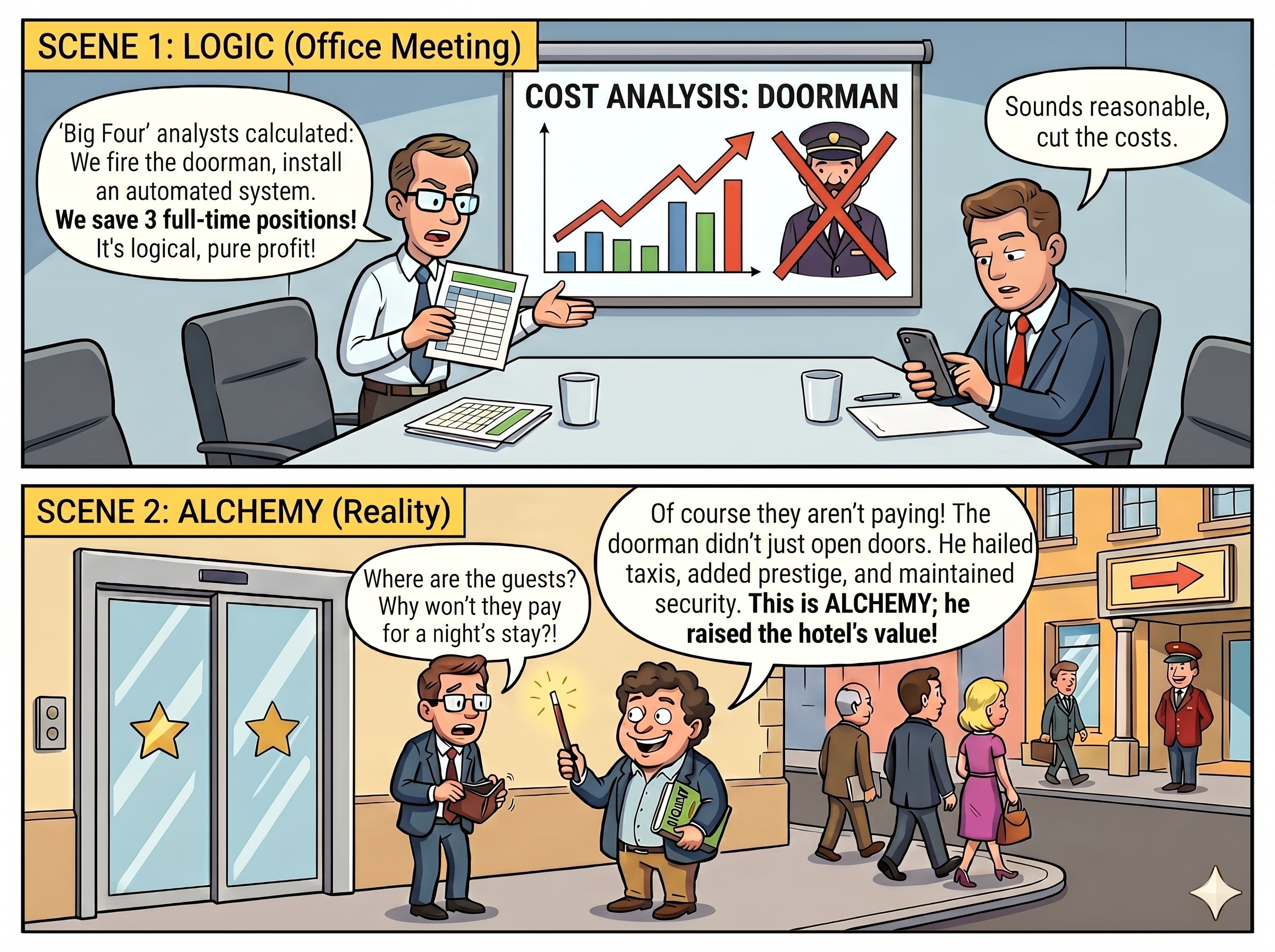
Zasady alchemi, według autora:
- Przeciwieństwo dobrego pomysłu też może być dobrym pomysłem.
- Nie projektuj pod przeciętną.
- Bycie logicznym nie popłaca, jeśli wszyscy inni też są logiczni.
- Natura naszej uwagi kształtuje naturę naszego doświadczenia.
- Kwiat to po prostu chwast z budżetem reklamowym.
- Problem z logiką polega na tym, że zabija magię.
- Trafne przeczucie, które broni się w zderzeniu z obserwacją, to wciąż nauka. Tak samo szczęśliwy przypadek.
- Testuj rzeczy nieintuicyjne właśnie dlatego, że nikt inny tego nie zrobi.
- Rozwiązywanie problemów samą racjonalnością jest jak gra w golfa jednym kijem.
- Miej odwagę być trywialnym.
- Gdyby istniała logiczna odpowiedź, już byśmy ją znaleźli.
A tutaj kilka (może kilkanaście) najważniejszych cytatów (zostawiam w oryginale, żeby nie utracić smaczków).
Rory Sutherland, Alchemy:
s.xi Because reductionist logic has proved so reliable in the physical sciences, we now believe it must be applicable every-where – even in the much messier field of human affairs. The models that dominate all human decision-making today are duly heavy on simplistic logic, and light on music – a spreadsheet leaves no room for miracle.
Rory Sutherland, Alchemy:
s.xiii The mythical “butterfly effect” does exist, but we don’t spend enough time butterfly hunting.
Rory Sutherland, Alchemy:
s.xiii Henry Ford famously despised accountants – the Ford Motor Company was never audited while he had control of it.
Rory Sutherland, Alchemy:
s.1 100,000 of the accounted envelopes had been delivered by volunteers; 100,000 encouraged people to complete a form which meant their donation would be boosted by a 25\% tax rebate; 100,000 were in better-quality envelopes; and 100,000 were in portrait format. (…) If you were an economist you would look at the results of this experiment and immediately conclude that people are completely insane. (…) The “rational” envelope – with tax rebate – in fact reduces donations by over 30 percent compared to the plain control, while the other three tests increase donations by over 10 per cent. The higher-quality paper also attracts a significantly higher number of more significant donations. (…) Perhaps it feels more natural to put notes or cheques in an envelope with the flap on a shorter edge. Putting a cheque for $100 into a thick envelope feels more agreeable than putting it into one made of cheap paper.
Rory Sutherland, Alchemy:
s.3 My assertion is that large parts of human behaviour are like a cryptic crossword clue: there is always a plausible surface meaning, but there is also a deeper answer hidden beneath the surface.
Rory Sutherland, Alchemy:
s.5 Logic is what makes a successful engineer or mathematician, but psycho-logic is what has made us a successful breed of monkey, that has survived and flourished over time.
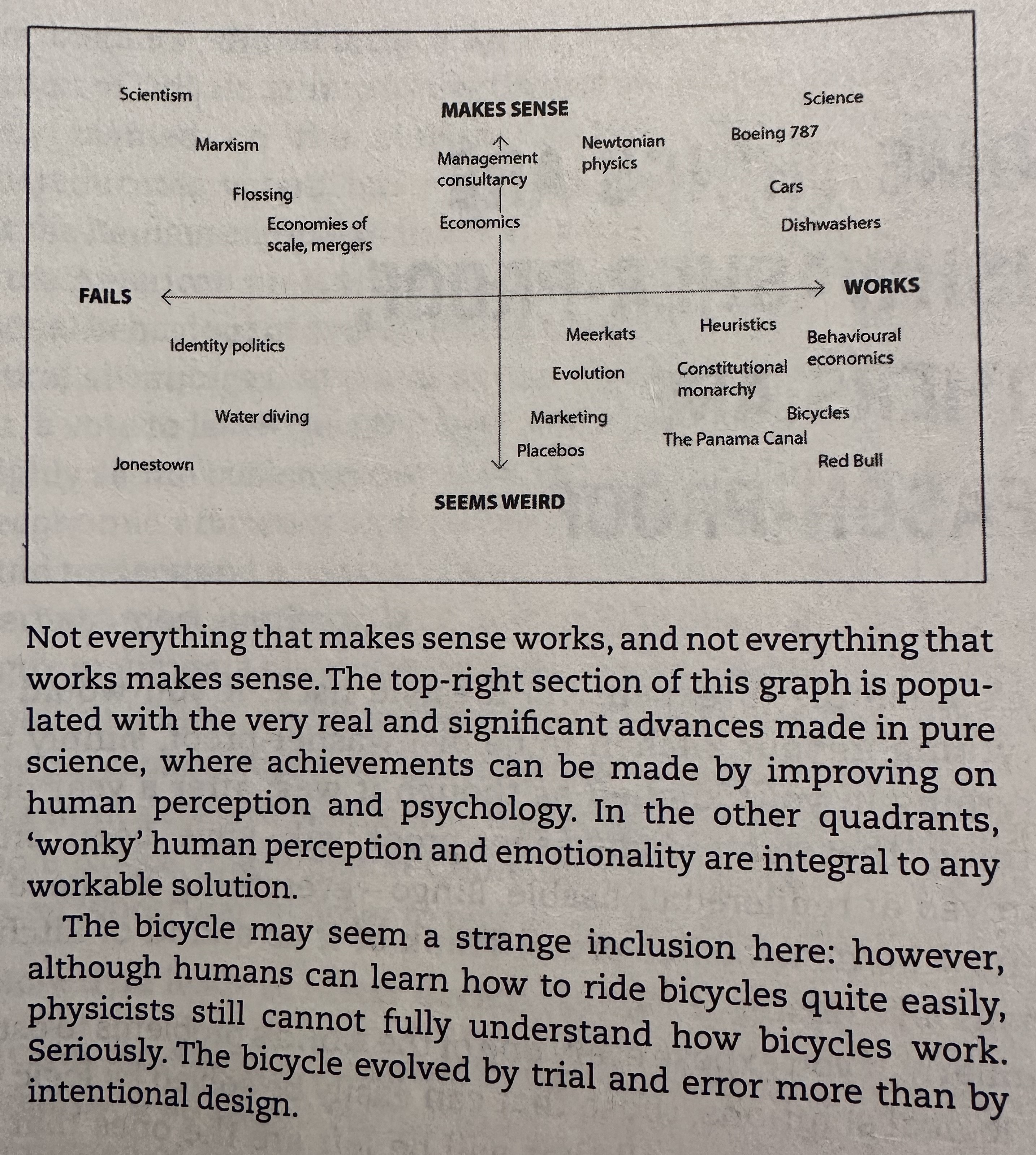
Rory Sutherland, Alchemy:
s.6 As the anthropologist Pierre Bourdieu observes, gift giving is viewed as a good thing in most human societies, but it only takes a very small change in context to make a gift an insult rather than a blessing; returning a present to the person who has given it to you, for example, is one of the rudest things you can do. Similarly, offering people money when they do something you like makes perfect sense according to economic theory and is called an incentive, but does not mean you should try to pay your spouse for sex.
Rory Sutherland, Alchemy:
s.9 For instance the victorious Brexit campaign in Britain and the election of Donald Trump in the US have both been routinely blamed on the clueless and emotional behaviour of undereducated voters, but you could make equally strong cases that the Remain campaign in Britain and Hillary Clinton’s failed bid for the American presidency failed because of the clueless, hyperrational behaviour of overeducated advisors, who threw away huge natural advantages. At one point we in Britain were even warned that ‘a vote to leave the EU might result in rising labour costs’ – by a highly astute businessman who was so enraptured with models of economic efficiency that he was clearly unaware most voters would understand a “rising in labour costs” as meaning a “pay rise”. (…) However the losing sides in both these campaigns have never once considered that their reliance on logic might have been the cause of their defeats, and the blame was pinned on anyone from “Russians” to “Facebook”. (…) In theory, you can’t be too logical, but in practice, you can. Yet we never seem to believe that it is possible for logical solutions to fail. After all, if it makes sense, how can it possibly be wrong?
Rory Sutherland, Alchemy:
s.11 The Nobel Prize winning behavioural scientist Richard Thaler said: “As a general rule the US Government is run by lawyers who occasionally take advice from economists. Others interested in helping the lawyers out need not apply”.
Rory Sutherland, Alchemy:
s. 12 Irrational people are much more powerful than rational people, because their threats are so much more convincing. (…) Being slightly bonkers can be a good negotiating strategy: being rational means you are predictable, and being predictable makes you weak. Hillary thinks like an economist, while Donald is a game theorist, and is able to achieve with one tweet what would take Clinton four years of congressional infighting. That’s alchemy; you may hate it, but it works. (…) If you are wholly predictable, people learn to hack you.
Rory Sutherland, Alchemy:
s.14 The single worst thing that can happen in a criminal investigation is for everyone involved to become fixated on the same theory, because one false assumption shared by everyone can undermine the entire investigation. There’s a name for this – it’s called “privileging the hypothesis”.
Rory Sutherland, Alchemy:
s.18 What are the great achievements of economics? Ricardo’s Theory of Comparative Advantage, perhaps? Or the General Theory of Employment, Interest and Money by John Maynard Keynes? And what is the single most important finding of the advertising industry? Perhaps it is that “advertisements featuring cute animals tend to be more successful than ads that don’t”.
Rory Sutherland, Alchemy:
s.19 Behavioural economics is an odd term. As Charlie Munger once said: “If economics isn’t behavioural, I don’t know what the hell is.” (…) Adam Smith was as much behavioural economist as an economist – The Wealth of Nations (1776) doesn’t contain a single equation. But strange though it may seem, the study of economics has long been detached from how people behave in the real world, preferring to concern itself with a parallel universe in which people behave as economists think they should.
Rory Sutherland, Alchemy:
s.21 In a 1996 survey on the place of religion in public life in America, the Heritage Institute found that:
- Churchgoers are more likely to be married, less likely to be divorced or single and more likely to manifest high levels of satisfaction in their marriage.
- Church attendance is the most important predictor of marital stability and happiness.
- The regular practice of religion helps poor people move out of poverty. Regular church attendance, for example, is particularly instrumental in helping young people escape the poverty of inner-city life.
- Regular religious practice generally inoculates individuals against a host of social problems, including suicide, drug abuse, out-of-wedlock births, crime and divorce.
- The regular practice of religion also encourages such beneficial effects on mental health as less depression, higher self-esteem and greater family and marital happiness.
- In repairing damage caused by alcoholism, drug addiction and marital breakdown, religious belief and practice are a major source of strength and recovery.
- Regular practice of religion is good for personal physical health: it increases longevity, improves one’s chances of recovery from illness and lessens the incidence of many killer diseases.
Rory Sutherland, Alchemy:
s.23 However, this fixation with sense-making can prove expensive. Imagine you are a company whose products are not selling well. Which of the following proposals would be easier to make in a board meeting called to resolve the problem? a) We should reduce the price. b) We should feature more ducks in our advertising.
Rory Sutherland, Alchemy:
s.28 In fact we derive pleasure from “expensive treats” and also enjoy finding “bargains”. By contrast, the mid-range retailer offers far less of an emotional hit; you don’t get a dopamine rush from mid-market purchases.
Rory Sutherland, Alchemy:
s.31 At the federal level I am Libertarian. At the state level, I am a Republican. At the town level, I am a Democrat. In my family I am a socialist. And with my dog I am a Marxist – from each according to his abilities, to each according to his needs.
Rory Sutherland, Alchemy:
s.34 You can never be fired for being logical. (…) The fatal issue is that logic always gets you to exactly the same place as your competitors.
Rory Sutherland, Alchemy:
s.35 There are logical problems, such as building bridge. And there are psycho-logical ones: whether to paint the lines on the road or not (or displaying cute animals in ads).
Rory Sutherland, Alchemy:
s.41 As Pascal put it: the heart has reasons of which reason knows nothing.
Rory Sutherland, Alchemy:
s.42 Robert Trivers gives an extraordinary example of a case where an animal having conscious access to its own actions may be damaging to its evolutionary fitness. When a hare is being chased, it zigzags in a random pattern is an attempt to shake off the pursuer. This technique will be more reliable if it is genuinely random and not conscious, as it is better for the hare to have no foreknowledge of where it is going to jump next: if it knew where it was going to jump next, its posture might reveal clues to its pursuer.
Rory Sutherland, Alchemy:
s.45 For a business to be truly customer-focused, it needs to ignore what people say. Instead it needs to concentrate on what people feel. (…) Why do people go to restaurants?, say. “Because they are hungry”, comes the answer. But if you think about it a little, someone merely hungry could satisfy their urge to eat far more economically elsewhere. Restaurants are only peripherally about food: their real value lies in social connection, and status.
Rory Sutherland, Alchemy:
s. 54 There are two lenses that decision-making has been using: “market research and economic theory”. The first lens is market research, or to give it a simpler name, asking people. However, the problem with it is that if we remember David Ogilvy’s words: “The trouble with market research is that people don’t think what they feel, they don’t say what they think, and they don’t do what they say”. People simply do not have introspective access to their motivations. The second lens is standard economic theory, which doesn’t ask people what they do and doesn’t even observe what they do. Instead it assumes a narrow and overly “rationalistic” view of human motivation, by focusing on theoretical, one-dimensional conception of what it believes humans are trying to do.
Rory Sutherland, Alchemy:
s.63 Until 1948, the Wright brothers’ Flyer was displayed not in the Smithsonian, but in the Science Museum in London. This might seem strange, but for years after the bicycle shop owners from Ohio had flown their manned heavier-than-air device on North Carolina’s Outer Banks, the US Government refused to acknowledge their achievement, maintaining that a government-sponsored programme had actually been first. In 1847, when Ignaz Semmelweis decisively proved that hand-washing by doctors would cut the incidence of puerperal fever, a condition that could be fatal during childbirth, he was spurned. All too often, what matters is not whether an idea is true or effective, but whether it fits with the preconceptions of a dominant cabal. I had always innocently assumed that after Edward Jenner discovered a vaccination against smallpox he would have presented his findings before sitting back to enjoy the acclaim. The truth was nothing of the kind; he spent the rest of his life defending his idea against a large number of people who had profited from an earlier practice called variolation, and were reluctant to admit that anything else was better. And if you think this problem is confined to history, consider the reaction to the invention of the electronic cigarette.
Rory Sutherland, Alchemy:
s.69 Making a train journey 20 per cent faster might cost hundreds of millions, but making it 20 per cent more enjoyable may cost almost nothing. (…) Put simply, it’s easy to achieve massive improvements in perception at a fraction of the cost of equivalent improvements in reality.
Rory Sutherland, Alchemy:
s.71 Why people buy electric drills. Well obviously you need to make a hole in something, to put up some shelves or something, and so you go out and buy a drill to perform the job… “I don’t think it works like that at all. You see an electric drill in a shop and decide you want it. Then you take it home and wander around your house looking for excuses to drill holes in things.” Similarly: why do people mostly buy ice cream in the summer? – to cool down on a hot day… The three countries with the highest per-capita ice cream sales in Europe? Finland, Sweden and Norway.
Rory Sutherland, Alchemy:
s.78 Sometimes the emotion is not appropriate – for instance, there is no reason for Brits to be afraid of spiders, since there are no poisonous spiders in the UK. (…) Other than in a few specialist jobs in zoos, there’s not much to be gained from not being afraid of spiders.
Rory Sutherland, Alchemy:
s.81 There Darwin could have learned from point-of-sale data that, over 30,000 items on the shelves, the single item most frequently purchased, as by all grocery shoppers in Britain, is… a banana.
Rory Sutherland, Alchemy:
s.82 As Nassim Nicholas Taleb remarks: “the way a question is phrased is itself information: “we are highly social creatures and just as we find it very difficult to answer the questions: “still or sparkling” with “tap”.
Rory Sutherland, Alchemy:
s.83 “A change in perspective is worth 80 IQ points”. The opposite is also true: the inability to change perspective is equivalent to a loss of intelligence.
Rory Sutherland, Alchemy:
s.85 When I speak to a very good mathematician, a typical phrase might be: “Yeah you could do a regression analysis, but the result is usually bollocks.”
Rory Sutherland, Alchemy:
s. 89 A game: toss a coin. If you win, you will get 50 per cent, if you lose, you lose 40 per cent. Would you play this game? I toss a coin twice: HH, HT, TH, TT. Out of starting $100, you end up with $225, $90, $90, $36. Only 25 per cent of us benefit out of this rule. Most of us lose (some of us severely).
Rory Sutherland, Alchemy:
s. 95 10 x 1 is not the same as 1 x 10. Imagine you have ten roles to fill, and you ask ten colleagues to each hire one person. Obviously each person will try to recruit the best person they can find – that’s the same as asking one person to choose the best ten hires he can find, right? Wrong! Anyone choosing a group of ten people will instinctively deploy a much wider variance than someone hiring one person. The reason for this is that with one person we look for conformity, but with ten people we look for complementarity.
Rory Sutherland, Alchemy:
s. 101 “Don’t design for average”. The sandwich was not invented by an average eater. The Earl of Sandwich was an obsessive gambler, and demanded food in a form that would not require him to leave the card table while he ate.
Rory Sutherland, Alchemy:
s. 120 We constantly rewrite the past to form a narrative which cuts out the non-critical points, and which replaces luck and random experimentation with conscious intent.
Rory Sutherland, Alchemy:
s. 123 One astonishing possible explanation for the function of reason only emerged about ten years ago: the argumentative hypothesis suggests reason arose in the human brain not to inform our actions and beliefs, but to explain and defend them to others.
Rory Sutherland, Alchemy:
s. 126 The problem arises because opening the door is only the notional role of a doorman; his other, less definable sources of value lie in a multiplicity of other functions, in addition to door-opening: taxi hailing, security, vagrant discouragement, customer recognition, as well as signalling the status of the hotel. The doorman may actually increase what you can charge for a night’s stay in your hotel.
Rory Sutherland, Alchemy:
s. 191 To borrow the language of the Michelin Guide, a flower can be “vaut l’etape”, “vaut le detour”, or “vaut le voyage”; “worth stopping at”, “worth going out of your way for”, or “destination in itself”.
Rory Sutherland, Alchemy:
s. 193 A company with a long-established reputation for high-quality products has much more to lose from customer disappointment than a company with no reputation. As a Caribbean proverb: “Trust grows at the speed of a coconut tree and falls at the speed of a coconut”.
Rory Sutherland, Alchemy:
s. 200 A Fisherian runaway selection – a quality that starts off being prized as a useful proxy for genetic fitness becomes exaggerated to an absurd degree. In animals this can be extraordinarily wasteful.
Rory Sutherland, Alchemy:
s. 204 The human brain’s capacity to handle a vast vocabulary may have arisen more for the purposes of seduction than anything else – but it also made it possible for you to read this sentence. (…) Why is there reluctance to accept that life is not just a narrow pursuit of greater efficiency and that there is room for opulence and display as well?
Rory Sutherland, Alchemy:
s. 222 In the words of Jonathan Haidt: “The conscious mind thinks it’s the Oval Office, when in reality it’s the press office”.
Rory Sutherland, Alchemy:
s. 228 Jonathan Haidt: self-placeboing. E.g., the strangest aspect of it is that we all spend a considerable amount of time and money essentially signalling to ourselves. In military: flags, drums, uniforms, square-bashing, regalia, mascots.
Rory Sutherland, Alchemy:
s. 235 It turns out that more is spent on female beauty than on education.
Rory Sutherland, Alchemy:
s. 253 In 1950s, the economist and political scientist Herbert Simon coined the term “satisficing”, combining as it does the words “satisfy”, and “suffice”. It is often used in contrast with the word “maximising” which is an approach to problem-solving where you obtain, or pretend to obtain, a single optimally right answer to a particular question. Simon used satisficing to explain the behaviour of decision makers under circumstances in which an optimal solution cannot be determined.
Rory Sutherland, Alchemy:
s. 256 The idea most simply expressed is this: “People do not choose Brand A over Brand B because they think Brand A is better, but because they are more certain that it is good.
Rory Sutherland, Alchemy:
s. 270 Blame, unlike credit, always finds a home – “Defensive Decision-Making” – making a decision which is unconsciously designed not to maximise welfare overall but to minimise the damage to decision maker in the event of a negative outcome.
Rory Sutherland, Alchemy:
s. 297 The Polish-American academic Alfred Korzybski (1879-1950) is perhaps most famous for his dictum that: “The map is not the territory”. He created a field called general semantics, and argued that because human knowledge of the world is limited by human biology, the nervous system and the languages humans have developed, no one can perceive reality, given that everything we know arrives filtered by the brain’s own interpretation of it.
Rory Sutherland, Alchemy:
s.312 There is a name for addition of customer effort to increase someone’s estimation of value. It should perhaps be called the Betty Crocker effect, since they spotted it first, but instead known as the IKEA effect, because the furniture chain’s eccentric billionaire founder was convinced that the effort invested in buying and assembling his company’s furniture added to its perceived value.
Rory Sutherland, Alchemy:
s. 343 The problem with logic is that it kills off magic. Or, as Niels Bohr apparently once told Einstein, “You are not thinking; you are merely being logical”